
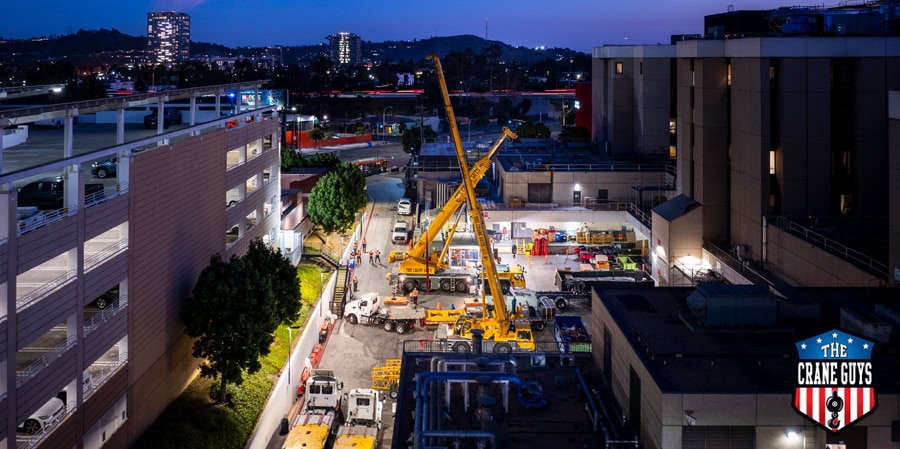
Crane lift planning becomes especially important when assembling a large crane in limited space at a fully operational medical facility. For a project in West Los Angeles, The Crane Guys coordinated a 360-ton crane and a compact 45-ton assist crane, planned their setup within tight site boundaries, and scheduled third-party inspections alongside night and weekend work.
Call: (562) 777-0600
Our team planned crane operations for the removal of existing air-handling units and associated ductwork, piping, and equipment. The challenge extended beyond lifting, the cranes, luffing jib components, support trucks, and crews all needed room to work within a constrained site.
The project demonstrates how Los Angeles crane services depend on equipment selection, site planning, and coordination long before lifting begins.
Planning Crane Assembly in a Restricted Work Area
A crane must fit the space needed for assembly and disassembly as well as its operating position. On this project, the available area left little flexibility in both width and length when the luffing jib was laid out for assembly.
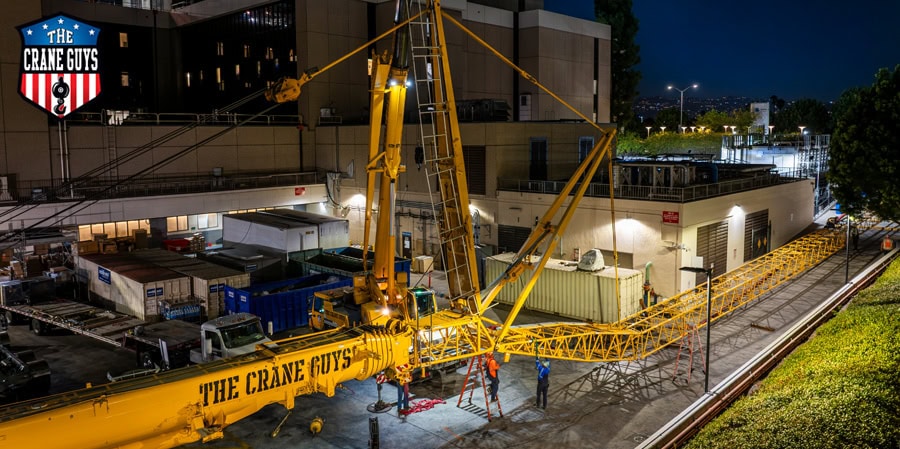
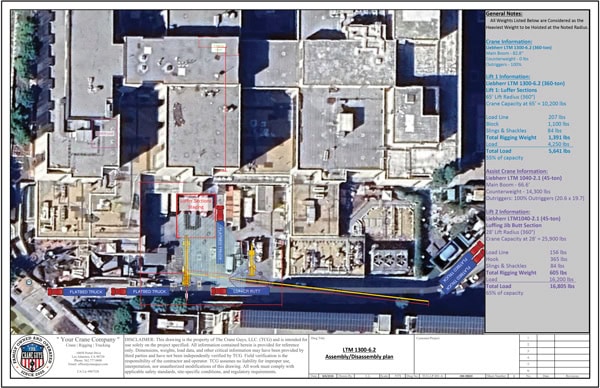 Our team recorded site dimensions and added information to the plan to help crews understand the setup requirements. Our lead project engineer worked with the project team to document the constrained layout and communicate those requirements before mobilization.
The planning package included crane positions, luffing jib staging areas, truck locations, and assembly details. These elements helped the crew prepare for the sequence of work within the available space.
The job was also reviewed with the crane operator several days beforehand. That discussion addressed the schedule and tight clearances, giving the operator advance context for the planned work.
Selecting the 360-Ton Crane and Luffing Jib Configuration
The main crane was a Liebherr LTM 1300-6.2, a 360-ton crane. The selection accounted for the lifting requirements and the space available to assemble the machine.
The planning documents demonstrated a 207-foot luffing jib and a planned 238-foot lift radius for air-handling-unit removal. That lift was modeled with a 7,000-pound equipment load and 1,510 pounds of rigging, block, and load-line weight, for a total planned load of 8,510 pounds.
These figures illustrate an important planning distinction, a crane’s nominal tonnage is not its lifting capacity at every radius. Capacity must be evaluated for the particular boom and jib configuration, counterweight, operating radius, and other applicable conditions.
The figures above describe the supplied planning configuration. Supporting sheets in the package are marked for pre-planning, and final field configurations require verification against the applicable operating documents.
Our 3D lift planning services help communicate the relationship between crane configuration, load location, and surrounding site constraints.
 How a Compact 45-Ton Assist Crane Helped the Setup
 How a Compact 45-Ton Assist Crane Helped the Setup
The second crane was a Liebherr LTM 1040-2.1, 45-ton assist crane. Its compact size helped the team work within the restricted area.
The assembly plan assigned this crane to handle the luffing jib sections. It modeled that task at a 28-foot radius, with a total planned load of 16,805 pounds, including the section and lifting accessories.
According to the project team, the 45-ton crane also helped reduce the need for support trucks. Fewer support vehicles meant less demand on the limited site space and helped control customer costs.
This is why crane selection involves more than choosing the largest machine. An appropriately selected assist crane can support assembly logistics while reducing the space and resources needed for the overall operation.
Coordinating Night and Weekend Work at a Live Medical Facility
The medical center remained operational, making scheduling central to the project.
The work required night operations and all-day work on Saturday and Sunday. Crews coordinated setup and breakdown around those requirements, working together to use the available work periods efficiently.
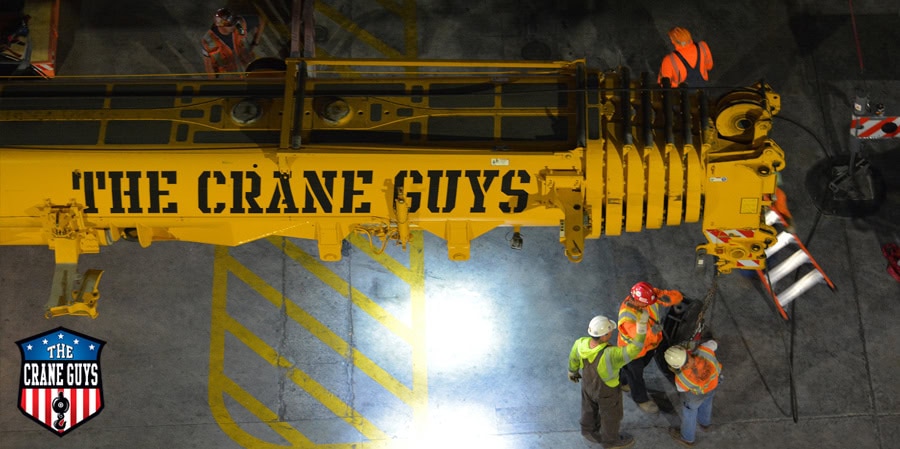
The Crane Guys provides 24/7 service, and this project offers a practical example of that availability, planning personnel, operators, crews, and inspection arrangements had to align with an unusual schedule.
For contractors arranging HVAC crane rental, the work window should be discussed early. It affects mobilization, assembly, inspections, lifting, and equipment removal.
Third-Party Inspections Before Site Work
Both cranes required third-party inspections on Friday evening before being permitted to work on site.
The 45-ton crane left the site Friday and required another third-party inspection before returning to work Sunday. That inspection took place at 4:30 a.m.
This detail shows why jobsite readiness includes more than getting a crane to the location. Site-specific inspection requirements and return visits must be coordinated with the operating schedule.
On this project, inspection timing was part of the preparation needed to support the planned work.
Trucking Removed Equipment to Scrap
The Crane Guys also provided trucking for the old equipment that needed to be hauled away to scrap.
At a constrained site, removal logistics deserve attention alongside crane setup. Trucks and loading activities use space that may also be needed for crane components and support equipment.
Coordinating flatbed trucking and scrap removal with the crane work helped address the equipment’s next step after removal from the facility.
What Contractors Can Learn From This Project
This Los Angeles project highlights five practical considerations for a restricted-site crane job:
- Account for assembly and disassembly space.
- Plan equipment haul-away as part of the site logistics.
The most useful plan gives the crew a clear understanding of the equipment, work area, and sequence before mobilization.
What should a reliable crane lift plan address?
It should address the planned crane configuration, load and rigging weights, operating radius, crane position, assembly areas, surrounding obstructions, ground-support requirements, truck staging, and work sequence. The exact requirements depend on the project and site.
Why use a 45-ton assist crane with a 360-ton crane?
The cranes can serve different tasks. On this project, the planning package assigned the 45-ton crane to handle a luffing jib butt section during assembly. The project team also reported that its compact size reduced the need for support trucks.
 Is luffing jib length the same as lift radius?
 Is luffing jib length the same as lift radius?
No. Jib length describes a crane component. Lift radius describes the horizontal distance from the crane’s center of rotation to the load line. The supplied plan for this project shows a 207-foot luffing jib and a 238-foot planned radius for air-handling-unit removal.
Can The Crane Guys coordinate night and weekend crane work?
Yes. The Crane Guys provides 24/7 service. This project required night work, Saturday and Sunday operations, and an early Sunday inspection for the returning assist crane.
Plan Your Next Los Angeles Crane Lift Project
If your project involves restricted access, HVAC equipment removal, or night and weekend work, involve the crane team early.
Share the project location, equipment weights and dimensions, lift locations, access restrictions, and proposed work schedule. The Crane Guys can discuss crane selection, lift planning and trucking requirements.
Request a crane service quote online or call (562) 777-0600 to discuss your project.

Our Service Areas
You’ll also appreciate the fact that The Crane Guys covers a wide swath of Southern California. We offer crane services in Los Angeles County, Orange County, Riverside County, San Bernardino, San Diego County, Ventura County and Kern County.